Author Archives: Joel Derfner

April 14, 2007
N.B.: I’m futzing with my comment mechanism. If you try to leave a comment and something funky happens, fear not; before long all shall be well and all shall be well and all manner of thing shall be well.
April 14, 2007
From the online journal of Dr. Saad Eskander, the Director of the Iraq National Library and Archive:
Jesus Christ.
April 11, 2007
Okay, it’s time for the second installment of ancient Egyptian 101. Since the first installment I have acquired a scanner, so fasten your seat belts.
(Something to keep in mind: “Hieroglyph” is a noun, referring to one of the symbols used in ancient Egyptian writing. “Hieroglyphic” is an adjective describing the writing system. So please don’t allow yourself to say things like, “The hieroglyphics on the walls of the tomb made me hard.” Please.)
Like most people, I used to think that each hieroglyph represented a word, sort of like how each Chinese character represents a word (such languages are commonly known as ideographic)*.
Like most people, I was wrong.
While it’s true that some glyphs represent words, more often than not glyphs are to be read phonetically, as consonants or groups of consonants. (Like ancient Hebrew writing, hieroglyphs represent only the consonants; the vowels are to be supplied by the reader. This isn’t as complicated as it sounds; if you saw “Grg W Bsh s th wrst prsdnt vr” you wouldn’t have too much trouble figuring out that it said “please, God, can we just skip to January 20, 2009?” especially if you were used to reading in this way.)
So this glyph, for example, representing a reed leaf, stands for the consonant [j].

This one, representing an owl, stands for the consonant [m].

This one, representing water, stands for the consonant [n].

“Amun” is the conventional rendering of the (divine) name made up of the consonants [jmn]. So this is how you write “Amun,” right?

Wrong.
Because the name of the god Amun is no more written with the leaf, owl, and water symbols than “airport” is spelled “eyreport.” I’m sure that when the ancient Egyptians texted each other they took shortcuts, but on sarcophagi they seem to have eschewed the ancient versions of “thru,” “thanx,” and “b4.”
So instead of the writing above (you say “writing” instead of “spelling”), the name “Amun” uses this glyph, representing a game board and game pieces, which stands for the consonants [mn].

So this is how you write “Amun,” right?

Wrong.
Because, since evidently carving these goddamned things into rock walls wasn’t tedious and difficult enough already, the Egyptians tended to add things called phonetic complements. A phonetic complement is a single-consonant sign that appears on either side of a double- or triple-consonant sign for absolutely no reason at all**. It would be sort of like writing “ass-fucking g” to make sure the reader knew the word ended with a “g,” or “c cocksucker” to make sure the reader knew the word started with a “c.”
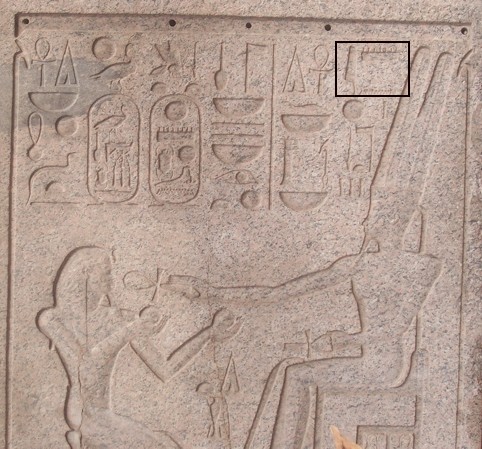
And the writing of “Amun” has a phonetic complement. So this is what it looks like:

Which is, as you can see, the first set of glyphs in this picture, at the top of the column directly to the left of the seated figure on the right.
Coming soon: ideograms and/or vowels.
My God, this is so much fun.
*Yes, I know that this kind of language is more correctly called logographic than ideographic, but give me a break. This blog is called The Search for Love in Manhattan.
**Okay, there are certain instances in which the phonetic complement helps clarify things, but those instances, as far as I can tell, are few and far between.
March 24, 2007
A note on the previous post: I mentioned to E.S. that I was writing a post about this conversation and he asked me to be very clear that he wasn’t officially diagnosing these people but rather noticing possible character traits. Apparently it is unethical to diagnose people you see on TV. So: E.S. wasn’t officially diagnosing these people but rather noticing possible character traits.
March 24, 2007
Having been out of the country, and having spent the week before our departure preparing, E.S. and I find ourselves with a great deal of TiVoed television to catch up on. We started last night, with America’s Next Top Model. This is what watching television with a psychiatrist is like:
(The girls have been doing various modeling things. Renee says something bitchy to Jaslene. Jaslene overreacts hugely. Renee tells Jaslene not to get defensive.)
E.S.: Pause it.
(Faustus pauses the TiVo.)
E.S.: Jaslene is displaying traits of narcissistic personality disorder. She’s feeling threatened by Renee, and she can’t take it, so she’s freaking out.
FAUSTUS: I don’t like her, anyway. She talks through her nose.
E.S.: Okay, we can keep watching now.
(Faustus unpauses the TiVo. All the girls continue competing to become America’s next top model. After a while, Jaslene says something bitchy to Renee. Renee overreacts hugely. Jaslene walks out. We cut to Renee alone, crying to the camera about how hard it is to be in the house.)
E.S.: Pause it.
(Faustus pauses the TiVo.)
E.S.: She’s displaying traits of narcissistic personality disorder.
FAUSTUS: You said that already.
E.S.: No, that was Jaslene. Now I’m talking about Renee. Jaslene can’t take it when she fails, so she just glosses over it as if it hadn’t happened. Renee can’t take it when she fails, so she’s falling apart. They’re having the same reaction, but it’s taking different forms. But Renee understands how it’s affecting Jaslene, so she keeps goading her. Jaslene is kind of helpless, because she doesn’t understand how it’s affecting Renee.
FAUSTUS: Why don’t you just say they all have narcissistic personality disorder and be done with it so we can see the rest of the show in peace?
E.S.: Because some of them might have borderline personality disorder.
FAUSTUS: Oh, God.
E.S.: We can keep watching now.
March 22, 2007
Here, from the Temple of Karnak, is one of the very few inscriptions I could read almost all of on the spot; a few minutes with my dictionary filled in the blanks (read this post if you’re confused about how we came to such a pass).

The figure on the throne on the right represents the god Amun-Ra, with an ankh, the symbol of life, in each hand. Even if we didn’t know it was Amun-Ra because he is always depicted wearing this hat, we would be able to figure it out from the inscription, which is in two parts. The first, directly above him, identifies him (reading from top to bottom, left to right): “Amun-Ra, king of the gods.” The second part, in the column on the left, says, “he gives him [the king] all stability and dominion.”
The seated figure on the left represents King Thutmose III. Note that he is King Thutmose, not Pharaoh Thutmose. The word “pharaoh” comes from the Egyptian for “great house,” a metonymic term for the king (similar to “the White House” used as a term for the President of the United States). However, “pharaoh” was not used as a title until the 10th century B.C., five hundred years after the 18th-dynasty Thutmose. (“Pharaoh” did first appear as a noun referring to the king in the 18th dynasty, but not, alas, until the reign of the heretic king Akhenaten, Thutmose III’s great-great-grandson (and father of your favorite boy-king and mine, Tutankhamun).)
The short version: we’re stuck with “king.”
His inscription, top to bottom and right to left, reads “The good god, Lord of the Two Lands, Lord Who Does Things, King of Upper and Lower Egypt Menkheperre Setepenre, Son of [the sun-god] Ra Tuthmose Neferkheperu, given all life like Ra forever.”
“Lord Who Does Things” seems suspiciously vague to me. What things? Things punishable in modern Egypt by prison with hard labor?
Menhkeperre Setepenre is Thutmose’s prenomen, which is a king’s most important official name and usually contains the name of Ra (or Amun, more or less interchangeable with him, sort of like Julia Stiles and Kate Hudson). Menkheperre means “lasting is the manifestation of Ra.” Previous kings had tended to use not Setepenre but Merenre, which means “beloved by Ra.” Thutmose broke with tradition and named himself Setepenre, “chosen by Ra.” This indicates to me that he was the kind of guy who, if he isn’t the center of attention at a dinner party, spends the evening making subtle digs about the furniture.
Thutmose Neferkheperu is the king’s nomen, the name he was given at birth. Thutmose means “Thoth [god of wisdom and writing] is born,” which confuses me; didn’t everybody assume Thoth was born? In which case wouldn’t it be better to be named something like “Thoth admires my triceps”? Neferkheperu means “beautiful of forms,” which I would comment on if I understood what the hell it meant.
(In addition to the prenomen and the nomen, a king usually had three more names; one represented him as the earthly manifestation of the god Horus, one represented his relationship with the vulture goddess of Upper Egypt and the cobra goddess of Lower Egypt, and one expressed a wish that he might be eternal. But the prenomen and the nomen are the ones you tend to find graven in stone.)
Okay, I was going to say that in the next post we’d discuss ideograms, phonograms, and determinatives in the above inscriptions, but as I read over what I have written I feel that it may be arrant enough pedantry for now. Don’t worry; we’ll get into ideograms, phonograms, and determinatives soon. We’ll just have a palate cleanser or two first.
My God, I started this blog with posts about orgies, and now I’m discussing royal titularies and dynastic succession as it relates to language change.
I recognize that this is very, very, very bad.
But I can’t stop myself.
March 21, 2007
Okay, sit down, because there’s something I have to tell you. Something I’ve been keeping from you for months. But I can’t stand the guilt anymore, so here goes:
Since September I have been taking a class in ancient Egyptian. (This is, of course, part of what motivated me to go to Egypt.)
Oh, how many were the days I longed to post scans of my homework assignments! To share with you my joy as my hieroglyphic writing improved! To laugh with you at the silly things those ancient Egyptians thought!
But, alas, I don’t have a scanner, and every time I tried to use somebody else’s I got a different kind of unusable file.
However, now I have photographs, and I’m going to inflict them on you.
Fear not; you won’t be subjected to all 1,282 of them.
But for the next little bit this blog is going to be very, very boring for people who have no interest in ideographic and/or phonographic writing systems.
I suggested to E.S. last night that I could change the name of my blog to The Search for Hieroglyphs on Egyptian Temples and Monuments From the Old Kingdom Through the Ptolemaic Period: A Gay Odyssey of Neurosis, but he said he thought the increased traffic would overwhelm my server.
By the way, once the class started, it became almost immediately clear to me that the personal ad I left in hieroglyphs a few years ago makes absolutely no sense at all.
Tomorrow: Thutmose III and Amun-Ra at the Temple of Karnak.
Be prepared.
March 20, 2007
by Faustus
1. Omar Sharif doesn’t look as good from the back.
2. The paucity of gay clubs in Egypt (I guess the whole “being gay is punishable by time in prison with hard labor oh and by the way you can’t appeal the sentence” thing gets in the way) leads boys who would ordinarily become go-go dancers to do this instead.
3. The camera really does add ten pounds.
(No fucking way am I posting a link.)
4. No matter where you go on earth, you will never escape the Titanic song.
March 11, 2007
Tomorrow E.S. and I start our cruise down the Nile, at which point there will be no Internet access for several days. This morning we saw the pyramids at Giza and the Sphinx but now there’s this girl Nefretiri who seems to have taken a liking to me and keeps running around tossing her hair saying things like, “Oh, Faustus, Faustus, you stubborn, splendid, adorable fool!” She’s kind of getting on my nerves, but I’m putting up with it because her brother Rameses is really hot in a kind of brutish way. I don’t think he likes me very much but I have some ideas about how to bring him around.
