Author Archives: Joel Derfner
June 8, 2007
I need your help with a project I’m working on.
Would you please take this short three-question survey?
(Two of the questions are yes/no and the third is optional.)
Your IP address will not be recorded and you will not be asked for your email address.
Thank you.
I could explain but I prefer to remain mysterious. Fear not, though; all will be made clear in the fullness of time.
Update: If your answer to question 3 is “sometimes,” then for my purposes that counts as “yes.” Act accordingly.
June 5, 2007
Opening night was fabulous.
The next night was more fabulous.
The next afternoon was more fabulous still.
Also, E.S., who came out to Seattle to see the show, has insisted that I recant my last post, because, as he points out, I did not vomit and faint at breakfast; I merely retched and swooned.
The first piece of mail I opened upon my return to New York tonight was a summons to jury duty. I can’t decide whether to do my damnedest to get on the jury so that I can fulfill my long-standing fantasy of participating in jury nullification or whether to retch and swoon so I can just go home instead.
May 31, 2007
My show opens tomorrow night.
I am choosing to interpret the fact that at breakfast this morning I both vomited and fainted as indicative of my nervousness about the show’s reception rather than of my unconscious feelings about what we have written.
May 18, 2007
With a great deal of concentrated effort, I have managed to translate most of the hieroglyphs in the ancient Egyptian final exam I posted a couple weeks ago. Here’s what I have so far.
“Please let me _____ your _____,” he begged, lost in lust. “I need your young stud _____ so bad, please give it to me.” I was only too happy to oblige. I ______ all ___ inches down his throat, mercilessly _______(ing) his face, my low-hanging _____ slapping his chin. ‘Officer, you sure do know your way around a _______,’ I moaned as his tongue ________ all over my _____, sucking gently on the head and ____________________ as his hands plied my heavy _______.”
I’m having a little trouble with the blanks; I think I need to get a more comprehensive dictionary.
May 11, 2007
For the last few days I have been in Seattle attending rehearsals for the show the man who has never been seen in the same room as me has written that’s being produced here.
Technically speaking, though I am going to bed and waking up in Seattle, where I am staying with my brother, I have been attending rehearsals in Issaquah, which is about 45 miles from Seattle. This means that I spend part of every day behind the wheel of a car.
As you might imagine, since I am a resident of New York City I am rarely called upon to drive. I also didn’t drive in college. With a handful of exceptions, I have not driven a car in more than fifteen years.
So watch the fuck out.
May 5, 2007
For my final exam in ancient Egyptian, I have to translate this (click on the picture to see an enlarged version):

May 1, 2007
For those unfortunate enough to have missed the Natasha-in-blackface moment on last week’s Top Model, here is visual evidence, courtesy of him.


April 29, 2007
In the second installment of ancient Egyptian 101, we talked about phonograms, glyphs that represent syllables. Today we’ll turn our attention to ideograms, glyphs that represent entire words.
This is actually a sloppy use of the term ideogram; signs that represent words are technically called logograms. An ideogram is a sign that represents an idea. The walk/don’t walk lights at street corners, for example, are ideograms; the picture of the walking person doesn’t represent the word “walk” so much as the idea that it’s okay to cross the street.
However, for whatever reason, logographic languages tend to be referred to as ideographic, so that’s what we’ll do here.
There are around 800 glyphs in written ancient Egyptian; of these, most are phonograms but some are ideograms. (Many glyphs can serve as either one, depending on context, but we’ll get to that later.) (There are also determinatives, but we’ll get to those later too.) Ideograms are more straightforward than phonograms, both to explain and to read.
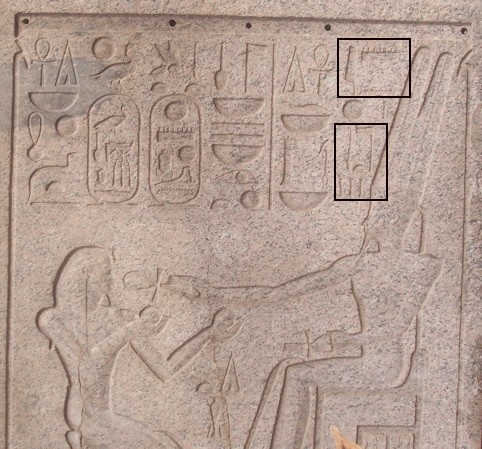
Last time we worked our way up to reading the inscription; we’ll start with it this time, and work backwards. The area I’ve marked contains the words for “king of the gods.”

Let’s break that down. The glyph all the way to the right represents a cloth wrapped around a pole (an ancient Egyptian emblem of divinity) and is an ideogram for the word [ntr], meaning “god” (the [t] is pronounced like, say, the final consonant in “my ex-boyfriend is a whoring bitch”).

So whenever you see this symbol, rather than having to remember what syllable it stands for and the figuring out what the syllables around it are and then deciding where the word breaks are and then looking it up in the dictionary and then not finding it and then crying because you are a miserable failure, you just know that it means “god.” Which, let me tell you, is a welcome relief.
The position of the glyph in this case indicates that it’s a genitive (crudely put, that you stick “of” before it), giving us “of the god.”
The last thing to note for now is the three little lines underneath the pole; these indicate the plural, which means that the second part of the marked area gives us “of the gods.”

Now let’s look at the first part, the word for “king,” made up of two phonograms, one representing a sedge plant (whatever the fuck that is) and the other representing a loaf of bread. The sedge plant stands for the consonants [sw]; the bread, for [t]. So the sedge-plant and bread glyphs stand for [swt], “king,” right?

Wrong.
The word for king is not [swt] but [nswt].
“What the fuck happened to the [n]?” I hear you cry. The answer is: They left it out. Because the inscription looked nicer that way.
I’ve dated people like them.
The word [nswt], “king,” is in fact written with our old friend the water glyph, standing for [n]:

So when the word [nswt] is written out in full, it looks like this, right?

Wrong.
Because the Egyptians, being a very aesthetically driven people (as we all know from Anne Baxter’s outfits in The Ten Commandments), found all the white space above and below the [n] and above the [t] displeasing. So they just moved the [n] to the other side; this is called graphic transposition. The word for “king” looks therefore like it’s spelled [swnt]. But it’s not.

This happens all over the place in hieroglyphic inscriptions. Luckily, some smart ancient Egyptians came up with a way to figure out whether this transposition is operating in any given case, and that way is you just have to know it and if you don’t then you’re fucked.
I’ve dated people like them, too.
Whoever carved the inscription in the present case took this principle a step further. Since spelling [nswt] with the [n] over the [t] would mean that the glyph for [ntr] might have to move a little bit to the right, which would in turn leave unpleasant white space, he just left the [n] out too. This, too, happens all over the place in hieroglyphic inscriptions, and this, too, operates according to the you-just-have-to-know-it-and-if-you-don’t-then-you’re-fucked principle. So you have the sedge-plant glyph and the bread-loaf glyph as well as a water glyph that’s been first transposed and then omitted*, standing for [nswt], “king.” Followed by the (pluralized) cloth wrapped around a pole, this gives you [nswt ntrw], “king of the gods.”

Putting that together with what we learned last time, we now have [jmn nswt ntrw], “Amun, king of the gods.”
The perspicacious among you may object to my having skipped the circle and the line in between the two marked portions of the inscription.
To which I reply: good things come to those who wait**.
*By the way, the transposition-omission bit can get even more confusing when, for example, the [t] bread loaf doesn’t appear in [nswt] either, which leaves you with the sedge-plant glyph to represent the word for “king.” Unless it represents [sw], the word for “him.” Unless it’s doubled and represents one of the words for “this/these.” Unless it’s doubled and represents one of the words for “not.”
Really, I have to give Champollion a lot of credit, because after five minutes with the Rosetta Stone I would totally have given up and gone to get ice cream.
**By the way, I’m making good progress on figuring out how to say “ass-fucking”; I’ve gotten “anus” and “backside.” Unfortunately I’ve found three different words for “pierce,” and I can’t figure out for the life of me what the different connotations are. And when one is dealing with ass-fucking that’s something one really doesn’t want to get wrong.
April 28, 2007
So today I watched the 2006 pilot of Aquaman (a.k.a. Mercy Reef).

Can somebody tell me why the fuck this show wasn’t picked up?
April 27, 2007
Okay, I just watched Wednesday’s Top Model.
Did they actually show Natasha walking down the house practice runway in blackface?
